The Ruby and Clojure Style Guides Get a Facelift
The community style guides for Ruby and Clojure (and their siblings for Rails, RSpec and Minitest) got a brand new look this week. That was long overdue and, as it turned out, way easier to do than I had expected.
A Bit of History
Back in 2019 I spent a lot of time converting the guides from Markdown to AsciiDoc and publishing them as websites for the first time. It’s no secret that I’m a big fan of AsciiDoc and I think it’s the best format for writing technical documentation. I’ve written about it here, there and everywhere, and the documentation of most of my bigger OSS projects is written in AsciiDoc.
Admittedly, I didn’t think much about the websites back then. Each guide is just a single
README.adoc, so I went with the simplest approach I could find:
asciidoctor -a toc="left" -a toclevels=2 README.adoc -o _build/html/index.html
Yeah, that’s the entire “site generator”. A CI job would run this command on
every push and publish the resulting index.html to GitHub Pages. At the time
I wrote that it’s much better to have great content than beautiful visuals
(although having them both would be ideal for sure) and I was certain that I’d
replace this setup with something fancier down the road. Fast-forward 7 years
and it was still there.1 Time sure flies fast!
The Problem
Here’s what the guides looked like until a few days ago:
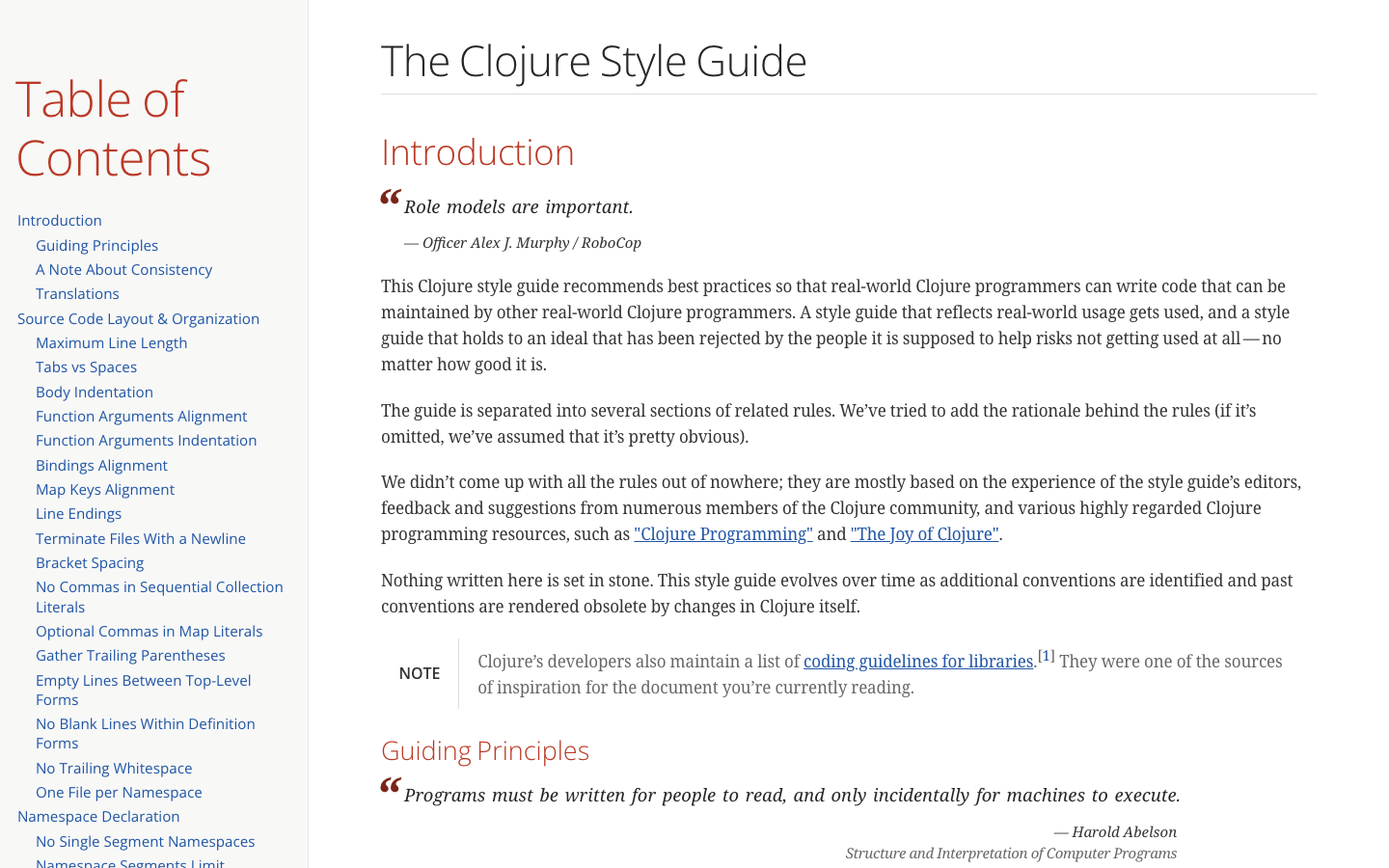
That’s Asciidoctor’s default stylesheet. It was fine in 2019, but it hasn’t aged that well, and over the years I’ve heard a few complaints about it:
- On a phone the entire table of contents is displayed at the top of the page. The Ruby guide has over 300 entries there, so you had to scroll for quite a while before you’d get to the actual content.
- There’s no dark mode.
- The tables look like something from mid-1990s web pages. That’s a pretty accurate description, if you ask me.
- The fonts are fetched from Google Fonts, which is a bit weird for a page that’s otherwise a single self-contained HTML file.
Thanks to Jun Kawai for bringing up the tables recently! That was the nudge I needed to finally do something about the looks of the guides.
From time to time I’ve considered moving the guides to Antora (which I’m using for the documentation of CIDER, nREPL and RuboCop) or some other static site generator, but that always seemed like an overkill to me. After all, each guide is a single document, right?
The Fix
In the end I didn’t need a different tool at all - I only needed a different
stylesheet. Asciidoctor allows you to replace its default stylesheet with your
own and to inject some HTML of yours into the page (that’s what the docinfo
attributes are for). Basically, the command above became:
asciidoctor -a toc=left -a toclevels=2 \
  -a stylesdir=theme -a stylesheet=guide.css \
  -a docinfo=shared -a docinfodir=theme \
  -a guide-accent='#cc342d' \
  README.adoc -o _build/html/index.html
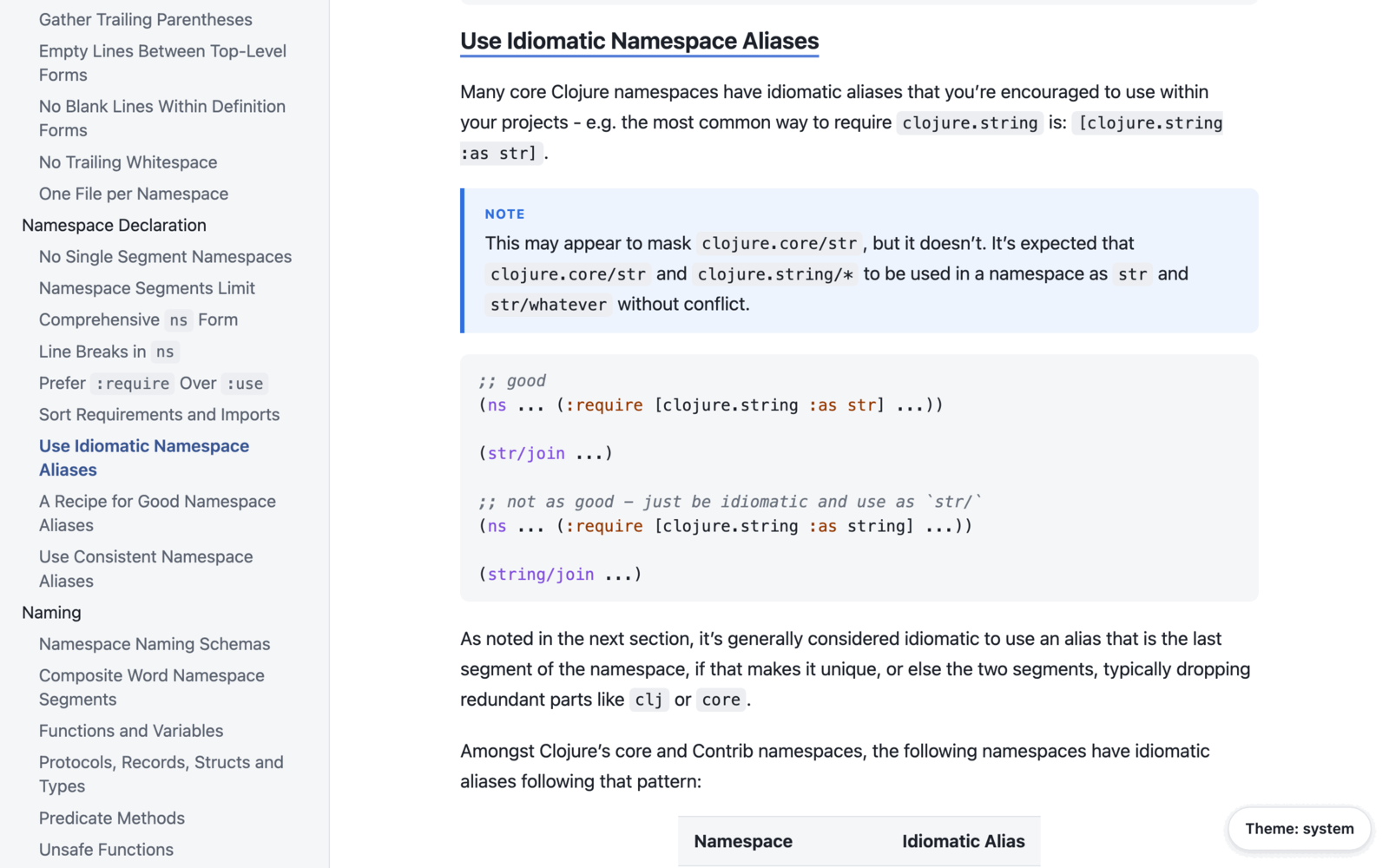
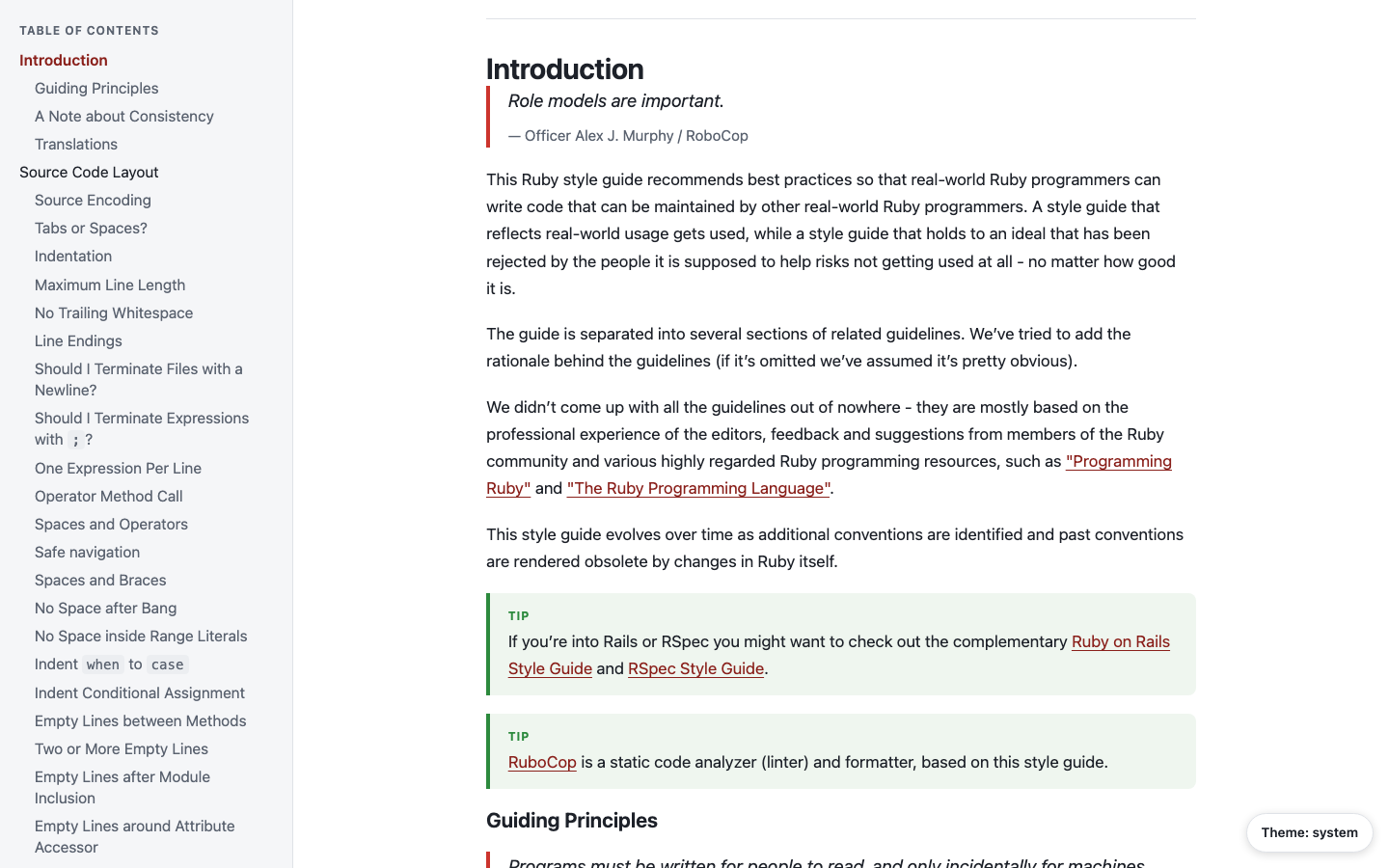
The output is still a single self-contained HTML file and I didn’t have to touch the AsciiDoc source of the guides at all. I was pretty glad that getting where I wanted to go was just a matter of using a different stylesheet. Here’s how the guides look today:
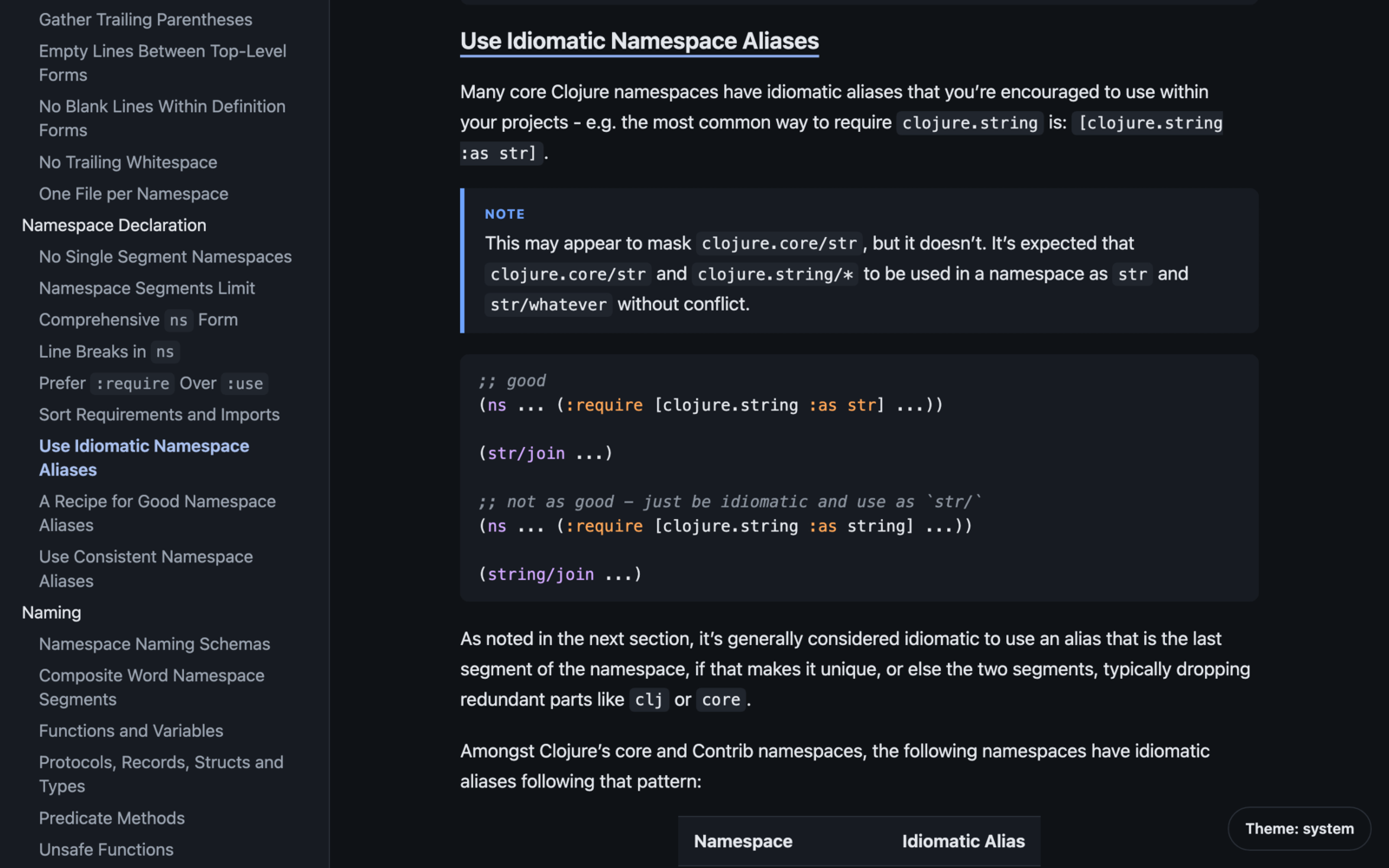
There’s a dark mode that follows your system settings (you can also switch between the modes manually):
And on small screens the table of contents is no longer in your way:
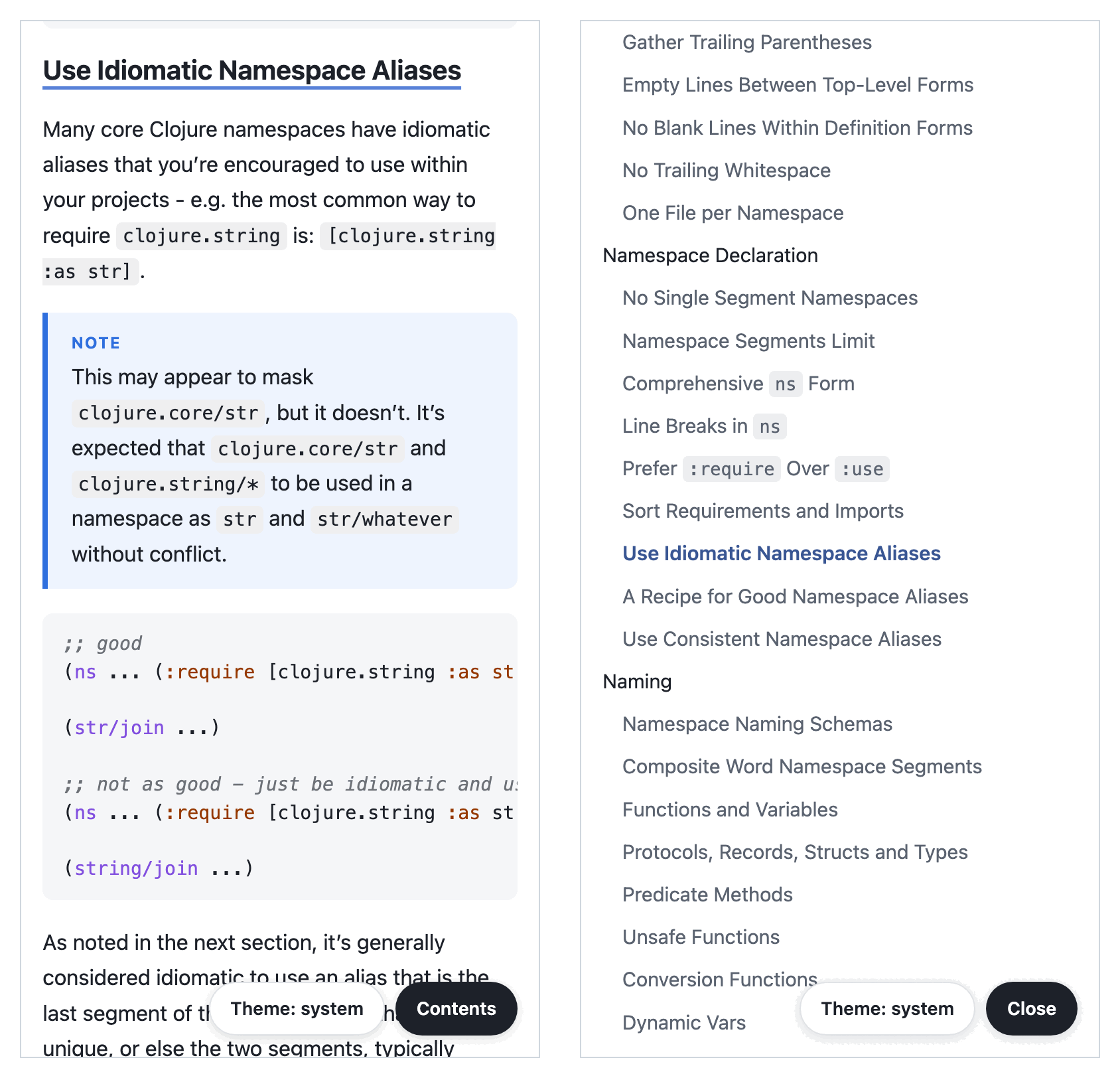
The sidebar also highlights the section that you’re currently reading, which is pretty handy for documents that long.
The Look
I’m no designer (as you can probably tell), so I didn’t try to come up with something original. I assume that most people reading the guides spend a lot of time on GitHub, so I aimed for something aligned with GitHub’s UI - the greys, the borders, the admonitions and the syntax highlighting are all pretty close to what you’d see there in light and dark mode. The theme relies on your system fonts, so nothing gets downloaded anymore.
The only difference between the guides is the accent colour. Each guide specifies a single colour (Clojure’s blue and Ruby’s red) and everything else is derived from it in CSS:
--accent: light-dark(var(--brand), color-mix(in oklch, var(--brand), white 30%));
--link: light-dark(color-mix(in oklch, var(--brand), black 25%),
                   color-mix(in oklch, var(--brand), white 50%));
In other words - the links are a darker shade of the accent on a light background and a lighter shade of it on a dark background, so they are easy to read in both modes. Modern CSS is pretty awesome! Not so long ago you’d need a preprocessor for something like this.2
One Theme to Rule Them All
All the guides share the same theme, which lives in a separate repository. It’s just a stylesheet, a little bit of JavaScript (for the theme switcher and the mobile menu) and a GitHub Action that wraps the command you saw earlier. Here’s all that it takes to build a guide now:
- uses: actions/checkout@v7
- uses: bbatsov/style-guide-theme@v1
  with:
    accent: '#5881d8'
While I was at it I also moved the Ruby guides from CircleCI to GitHub Actions, so now all the guides are built and deployed in exactly the same way. There’s nothing specific to style guides in the theme, so feel free to use it for your own AsciiDoc documents if you like it.
Epilogue
I’m sure that the new look has some rough edges. I haven’t tested it on that many browsers and devices, and I guess that not everyone will like my choice of colours. If you notice any problems - please, let me know! Issues and pull requests are always welcome!
Looking back, I’m glad I went with something that simple in 2019. I never expected it’d stay in place for so many years, but simple solutions are also the easiest to improve when the time for this finally comes. Once again I was reminded that “less is more”.
That’s all I have for you today. Keep hacking!